and each family's story embodies its hope and despair." --Auguste Napier
Erik,
John and Ellen Strutt were Momma's grandparents (on her father's side), and she remembers quite a lot about them. --Mom
"The name of Strutt is one of the oldest names in the village of Oxton. The Strutt name was first recorded in Oxton's church in the 1600's. Another old name in the village is Sherbrook. They were the village squires and landowners and lived in Oxton Hall, the manor house. (A manor house is a country house that belongs to the gentry.) John Strutt, my granddad and Albert Edward Strutt, my dad, worked as gardeners at Oxton Hall.
John and Ellen Strutt, my grandparents, lived in a three-story, red-brick house at the corner of Flats Lane, and owned by Squire Sherbrook. There was no running water in the home, only a cold-water tap outside the kitchen door. Their ten children were born in that home, seven sons and three daughters, one of whom died at age 9.
A piece of land, called 'The Croft,' adjoined the house. It was there that my granddad raised bantam hens. There were also fruit trees on the property.
The Methodist Chapel stood opposite their home; during the late 1800's, the chapel was the center of a religious revival in the area.
As children Molly and I were taken often to visit our grandparents. We looked forward to these visits for we would ride on a Barton's bus to Oxton which was a distance of seven miles from Arnold. A Barton's bus was a single level bus, red in color, and ran often through the villages. On the way to Oxton there was a water splash that ran across the road and the driver would speed up to go over the splash becasue he knew we kids would scream out.
Once there, Uncle Pat (Ernest) would slip us a few pennies each, and off we went to the village sweet shop. We'd stand there amongst the jars of sweeties and boxes of toffees and try to decide what to buy with our pennies. Then he would take us to a lady named Nell Gibson who made the best ice cream. We would also enjoy looking for eggs in Granddad Jack's henhouse. Granddad, along with Uncle Pat and Uncle Fred, cultivated three allotments with all manner of fruit, berries, and vegetables. We delighted in picking and eating our fill.
I always felt intimidated around Granny Strutt. Even in the 1930's she still wore the dress of the early 1900's--an ankle length brown skirt and a white cotton long-sleeved blouse with a drawstring neckline. Over the skirt she wore a full length apron. Her gray hair was pulled back into a tight bun, and her face was deeply wrinkled. I don't ever remember her showing affection to us grandchildren. I don't remember ever having a kiss from her.
Granny Strutt passed away in 1938 at age 79. I remember her funeral. There were no cars allowed, and her oak coffin was placed on a bier (cart). Two men in black top hats and cut away coats walked in front holding the handles and two more walked behind the bier. The family followed the bier, walking two by two, starting with the eldest son and his wife. The grandchildren followed in order at the rear. As we walked through the village to the church, friends and neighbors were waiting to join the end of the procession, behind the family. There was quite a gathering as we entered the church.
Granddad Strutt was the most wonderful gentleman. He was small in stature, had white hair, and a white walrus mustache. He was always dapper, dressed in a navy blue suit with waistcoat (vest), even in the house, and he was spotlessly clean. I don't every remember him being angry; he was very soft-spoken. Mam thought the world of him, and when he lay dying, she was the one he asked for, and she sat beside him for almost a week. I think she truly felt she had lost a wonderful friend when her father-in-law died. He died in 1943 at age 83." --Joan Shelton
Tuesday, August 14, 2012
Wednesday, August 1, 2012
"The family."
"The family. We were a strange little band of characters trudging through life sharing diseases and toothpaste, coveting one another's desserts, hiding shampoo, borrowing money, locking each other out of our rooms, inflicting pain and kissing to heal it in the same instant, loving, laughing, defending, and trying to figure out the common thread that bound us all together. ~Erma Bombeck
Erik,
I know a little about Poppa's mother's family, Charles and Anna Langford. They would be my great-grandfather and great-grandmother. Dad wrote down his memories of them.
--Mom
Charles Langford was a stonemason who worked on many churches around Nottingham-
shire. According to Poppa, he was a tyrant at home. He was tall with the typical handlebar 'tash' (mustache) of the day.
He enlisted or was drafted into the army in World War 1 at the age of 37. He survived the war, returning home in 1919, caught the Spanish flu, and died in 1920 at the age of 42. At his death he left his wife, Anna Maria Langford and 10 children, 7 girls and 3 boys--Ada, Ellen (Nell), Emily (my grandmother), Arthur, Richard, Connie, Mabel, Charles, Florrie, and Hilda.
Bit of history: "The 1918 flu (the "Spanish flu") was an influenza pandemic. It was an unusually severe and deadly pandemic that spread across the world. Most victims were healthy young adults.
The pandemic lasted from January 1918 to December 1920. Between 50 and 130 million died, making it one of the deadliest natural disasters in human history. Even using the lower estimate of 50 million people, 3% of the world's population (which was 1.86 billion at the time) died of the disease. Some 500 million, or 27%, were infected."
'World War I did not cause the flu, but the close troop quarters and massive troop movements hastened the pandemic and probably both increased transmission and augmented mutation; it may also have increased the lethality of the virus. Some speculate the soldiers' immune systems were weakened by malnourishment, as well as the stresses of combat and chemical attacks, increasing their susceptibility."
'The fetid, rat-rich, body-rotting trenches provided ideal breeding grounds for the virus that would be responsible for more than five times as many deaths as the war itself.'
Charles's wife, Anna Maria Langford, was, according to Poppa who knew her, a 'strong willed woman who would drink a jug of ale every day of her life.' (Probably because she had 10 children!) The children all lived to adulthood.
She was a very good looking woman with auburn hair and dark eyes. She had breast cancer at 56, had her breasts removed, and lived on until age 72. One of her 10 children preceded her in death. Florrie died in 1942 at age 42 of breast cancer.
Erik,
I know a little about Poppa's mother's family, Charles and Anna Langford. They would be my great-grandfather and great-grandmother. Dad wrote down his memories of them.
--Mom
Charles Langford was a stonemason who worked on many churches around Nottingham-
shire. According to Poppa, he was a tyrant at home. He was tall with the typical handlebar 'tash' (mustache) of the day.
![]() |
| typical work of a stonemason |
![]() |
| a stonemason working on an arch--note the bow tie? |
He enlisted or was drafted into the army in World War 1 at the age of 37. He survived the war, returning home in 1919, caught the Spanish flu, and died in 1920 at the age of 42. At his death he left his wife, Anna Maria Langford and 10 children, 7 girls and 3 boys--Ada, Ellen (Nell), Emily (my grandmother), Arthur, Richard, Connie, Mabel, Charles, Florrie, and Hilda.
Bit of history: "The 1918 flu (the "Spanish flu") was an influenza pandemic. It was an unusually severe and deadly pandemic that spread across the world. Most victims were healthy young adults.
The pandemic lasted from January 1918 to December 1920. Between 50 and 130 million died, making it one of the deadliest natural disasters in human history. Even using the lower estimate of 50 million people, 3% of the world's population (which was 1.86 billion at the time) died of the disease. Some 500 million, or 27%, were infected."
'World War I did not cause the flu, but the close troop quarters and massive troop movements hastened the pandemic and probably both increased transmission and augmented mutation; it may also have increased the lethality of the virus. Some speculate the soldiers' immune systems were weakened by malnourishment, as well as the stresses of combat and chemical attacks, increasing their susceptibility."
'The fetid, rat-rich, body-rotting trenches provided ideal breeding grounds for the virus that would be responsible for more than five times as many deaths as the war itself.'
![]() |
| On Armistice Day, 1918, Britain is in the grip of the Spanish flu. |
Charles's wife, Anna Maria Langford, was, according to Poppa who knew her, a 'strong willed woman who would drink a jug of ale every day of her life.' (Probably because she had 10 children!) The children all lived to adulthood.
She was a very good looking woman with auburn hair and dark eyes. She had breast cancer at 56, had her breasts removed, and lived on until age 72. One of her 10 children preceded her in death. Florrie died in 1942 at age 42 of breast cancer.
Tuesday, July 31, 2012
"A man finds room in the few square inches of the face . . .
for the traits of all his ancestors; for the expression of all his history, and his wants."
--Ralph Waldo Emerson
Erik,
What follows is the limited information I have of Poppa's grandparents, my great-grandparents. I include it because it is quite interesting. This information come from Poppa and from my cousin, Anne Shelton.
--Mom
Albert Shelton, Poppa's grandfather, was born March 23, 1869. He was the sixth child of what would become a family of eight. He was known my the nickname "Mickey" all his adult life. In June 1897, he married Maria Oscroft. She already had two sons, John Henry Oscroft and Fredrick Albert Oscroft. When Albert married Maria he was listed in the 1901 Census as a coal miner but by 1904 he was a shop keeper. Maria's family perhaps 'had a bob or two' and Albert may have been given a good dowry for marrying Maria and raising her two sons.
FYI: a 'bob' is old British slang for a shilling. A shilling is a former British coin equal to one twentieth of a pound or twelve pence.
Albert and Maria had four sons of their own, eldest to youngest, Joe (my grandfather), Jack, Bill and Tom. Albert had a horse and dray which he would drive to the neighboring villages of Calverton, Oxton, Epperstone and Woodborough, selling china, glassware, and paraffin oil for lamps.
Often one or more of his boys would ride with him on the dray, helping to tether the horse and keep watch over the goods while Albert was doing business. He had a set route which he and the lads did whatever the weather conditons because people would be relying on him, especially for paraffin oil for their lamps. He also had a shop at 74 Front Street in Arnold. Maria ran the shop. Their home was at the rear of the property.
Maria and Albert's son, Jack, remembered that he and his brothers went to Sunday school. He said it wasn't really like school, but rather "somewhere to go when it was raining, somewhere to go and have a sing, or a have a Bible story told us." He remembered once getting a 'bat up't tab' (a smack round the ear) from the Sunday school teacher for singing the wrong words to a hymn. Their lyrics went something like this:
"There is a happy land, far, far away.
Where they eat bread and jam three times a day.
Oh how they slap it on."
Once, Albert and Joe, 'borrowed' a rickety old bike from outside a gate in Arnold. No tires, just steel rims on the wheels and no brakes. They rode off with the bike toward Arch Hill planning on a few 'croggies' down the hill. (A croggy is a ride on the handlebars of a mate's bike.) Things didn't go as planned; they lost control and hit the wall of the old Coaching Inn at the bottom of Arch Hill.
The front wheel was so badly buckled the boys were scared to take it back. They threw the bike into a pond in front of the inn. For weeks after whenever they heard a knock at the door, they panicked. They thought it was the local bobby (police officer), Bobby Wilson coming to lock them up.
When the boys were young, everyone in the family learned a song, poem, or story to recite and entertain the rest of the family on Sunday evening or at family get-togethers.
FYI: The first television wasn't invented until the late 1920's.
The kerosene lamp (widely known in Britain as a paraffin lamp) is a type of lighting device that uses kerosene as a fuel. Kerosene lamps have a wick or mantle as a light source, protected by a glass chimney or globe; lamps may be used on a table, or hand-held lanterns may used for portable lighting.
Sadly, Albert Shelton died of chronic bronchitis and heart failure in November 1911, at the age of 42. He left behind a wife, Maria, and six sons.
On August 13th, 1918, John Henry Oscroft, Albert's stepson, a private in the Sherwood Foresters (Notts and Derby Regt) was killed in action in Proyat, France. He along with 518 other soldiers lost their lives just twelve weeks before the end of the war. He was 24 years old.
One year later on February 25, 1919, Maria Oscroft Shelton, died from bronchitis at the age of 44.
Her youngest son, Thomas, would've been about 17 at her death. It is not known who took in the boys. Perhaps their grandparents?
--Ralph Waldo Emerson
Erik,
What follows is the limited information I have of Poppa's grandparents, my great-grandparents. I include it because it is quite interesting. This information come from Poppa and from my cousin, Anne Shelton.
--Mom
Albert Shelton, Poppa's grandfather, was born March 23, 1869. He was the sixth child of what would become a family of eight. He was known my the nickname "Mickey" all his adult life. In June 1897, he married Maria Oscroft. She already had two sons, John Henry Oscroft and Fredrick Albert Oscroft. When Albert married Maria he was listed in the 1901 Census as a coal miner but by 1904 he was a shop keeper. Maria's family perhaps 'had a bob or two' and Albert may have been given a good dowry for marrying Maria and raising her two sons.
FYI: a 'bob' is old British slang for a shilling. A shilling is a former British coin equal to one twentieth of a pound or twelve pence.
Albert and Maria had four sons of their own, eldest to youngest, Joe (my grandfather), Jack, Bill and Tom. Albert had a horse and dray which he would drive to the neighboring villages of Calverton, Oxton, Epperstone and Woodborough, selling china, glassware, and paraffin oil for lamps.
Often one or more of his boys would ride with him on the dray, helping to tether the horse and keep watch over the goods while Albert was doing business. He had a set route which he and the lads did whatever the weather conditons because people would be relying on him, especially for paraffin oil for their lamps. He also had a shop at 74 Front Street in Arnold. Maria ran the shop. Their home was at the rear of the property.
![]() |
| a dray, a low cart for delivering loads, usually pulled by one horse |
"There is a happy land, far, far away.
Where they eat bread and jam three times a day.
Oh how they slap it on."
Once, Albert and Joe, 'borrowed' a rickety old bike from outside a gate in Arnold. No tires, just steel rims on the wheels and no brakes. They rode off with the bike toward Arch Hill planning on a few 'croggies' down the hill. (A croggy is a ride on the handlebars of a mate's bike.) Things didn't go as planned; they lost control and hit the wall of the old Coaching Inn at the bottom of Arch Hill. The front wheel was so badly buckled the boys were scared to take it back. They threw the bike into a pond in front of the inn. For weeks after whenever they heard a knock at the door, they panicked. They thought it was the local bobby (police officer), Bobby Wilson coming to lock them up.
When the boys were young, everyone in the family learned a song, poem, or story to recite and entertain the rest of the family on Sunday evening or at family get-togethers.
FYI: The first television wasn't invented until the late 1920's.
The kerosene lamp (widely known in Britain as a paraffin lamp) is a type of lighting device that uses kerosene as a fuel. Kerosene lamps have a wick or mantle as a light source, protected by a glass chimney or globe; lamps may be used on a table, or hand-held lanterns may used for portable lighting.
Sadly, Albert Shelton died of chronic bronchitis and heart failure in November 1911, at the age of 42. He left behind a wife, Maria, and six sons.
On August 13th, 1918, John Henry Oscroft, Albert's stepson, a private in the Sherwood Foresters (Notts and Derby Regt) was killed in action in Proyat, France. He along with 518 other soldiers lost their lives just twelve weeks before the end of the war. He was 24 years old.
One year later on February 25, 1919, Maria Oscroft Shelton, died from bronchitis at the age of 44.
Her youngest son, Thomas, would've been about 17 at her death. It is not known who took in the boys. Perhaps their grandparents?
Sunday, July 15, 2012
“There is no king who has not had a slave among his ancestors . . .
and no slave who has not had a king among his." --Helen Keller
Erik,
I was planning next to go forward to my childhood, but Momma sent me a page or two of
memories about her grandparents, William and Sophie Bradley. I couldn't leave these wonderful stories out.
--Mom
"My mom, Hannah Sophia Bradley, was born in the village of Woodborough, in the county of Nottinghamshire, England, on April 7, 1885. Her parents were William and Sophie Bradley. As a young man, Granddad Bradley 'took the King's shilling' to escape the law for scrumping (stealing) apples from a village orchard. 'Taking the King's shilling' meant enlisting in the army to avoid charges. He was sent to the Crimean War. While in Turkey he met and married the daughter of an army sergeant, but on the return journey to England by ship, she and the baby she was carrying, died in childbirth and both were buried at sea.
After reaching England, William Bradley returned to Woodborough and there met and married Sophia Reddish, my grandmother. He was quite a bit older than her; they had one son, Richard, stillborn twins, and finally, Hannah Sophia, my mam, and Jane, my Aunt Jinny.
The Reddish family had long ago been wealthy landowners around Nottingham. There is an old watermill at Halam, near Woodborough, that once belonged to the family. In the 12th century the name Reddish was deReddish, so it was probably of Anglo-Saxon or French origin.
My granddad became a stocking frame operator. The frame sat in the front room. He would 'knit' the stockings on the frame, and then walk to Arnold and deliver them to Allen and Solley's Factory to be seamed and shaped. His daughter, Hannah, my mam, often accompanied him. She told me that Granddad worked on silk stockings for Queen Victoria. He worked her design, a crown over a V and an R (for Victoria Regina) into the top of the stocking.
Granddad decided he would teach Mam to run the stocking frame; she hated it! It made a sound--'shinka-pom-push' as the pedals were worked. This went on for hours. One morning, after much protesting on her part, he nonetheless made her get on the frame to work. She got so fed up of hearing that 'shinka-pom-push' that she stamped her feet on the pedals and jammed the needles together. Scared that she'd broken the frame, she ran off into the orchard and never again was she made to work on that machine. --Joan Shelton
Bit of history: In July 1853, Russia occupied territories in the Crimea, a peninsula in the Ukraine, that had previously been controlled by Turkey. Britain and France were concerned about Russian expansion and attempted to achieve a negotiated withdrawal. Turkey, unwilling to grant concessions, declared war on Russia. In November 1853, Britain and France joined the war against Russia.
A stocking frame was a mechanical knitting machine used in the textiles industry. It was invented by William Lee of Calverton near Nottingham in 1589. Its use, known traditionally as framework knitting, was the first major stage in the mechanization of the textile industry, and played an important part in the early history of the Industrial Revolution.
Amy Symington from Lyon & Turnbull models a pair of hand stitched silk stockings on February 24, 2010 in Edinburgh, Scotland. The Scottish auctioneers are due to place the hand-stitched, silk stockings in their sale on March 24, 2010. Complete with crests this style of stocking is thought to have been among Queen Victoria's favorites.
"Mam had an uncle living on a farm at the end of the village. He was a strong Methodist. Every Saturday they swept out his barn and arranged forms (wooden benches) for seating. The first Methodist Church in Woodborough began in that barn. Eventually the 'church' was granted a deed from the diocese and was able to build a chapel.
Granddad Bradley took ill, becoming paralyzed and remained bedridden until his death. We now know he died of Amyotrophic Lateral Sclerosis (Lous Gehrig's disease), the same disease my brother Jack died of in 1972. After her dad died, at the age of 12, Mam was sent to work at Woodborough Parsonage." --Joan Shelton
Erik,
I was planning next to go forward to my childhood, but Momma sent me a page or two of
memories about her grandparents, William and Sophie Bradley. I couldn't leave these wonderful stories out.
--Mom
"My mom, Hannah Sophia Bradley, was born in the village of Woodborough, in the county of Nottinghamshire, England, on April 7, 1885. Her parents were William and Sophie Bradley. As a young man, Granddad Bradley 'took the King's shilling' to escape the law for scrumping (stealing) apples from a village orchard. 'Taking the King's shilling' meant enlisting in the army to avoid charges. He was sent to the Crimean War. While in Turkey he met and married the daughter of an army sergeant, but on the return journey to England by ship, she and the baby she was carrying, died in childbirth and both were buried at sea.
After reaching England, William Bradley returned to Woodborough and there met and married Sophia Reddish, my grandmother. He was quite a bit older than her; they had one son, Richard, stillborn twins, and finally, Hannah Sophia, my mam, and Jane, my Aunt Jinny.
The Reddish family had long ago been wealthy landowners around Nottingham. There is an old watermill at Halam, near Woodborough, that once belonged to the family. In the 12th century the name Reddish was deReddish, so it was probably of Anglo-Saxon or French origin.
My granddad became a stocking frame operator. The frame sat in the front room. He would 'knit' the stockings on the frame, and then walk to Arnold and deliver them to Allen and Solley's Factory to be seamed and shaped. His daughter, Hannah, my mam, often accompanied him. She told me that Granddad worked on silk stockings for Queen Victoria. He worked her design, a crown over a V and an R (for Victoria Regina) into the top of the stocking.
Granddad decided he would teach Mam to run the stocking frame; she hated it! It made a sound--'shinka-pom-push' as the pedals were worked. This went on for hours. One morning, after much protesting on her part, he nonetheless made her get on the frame to work. She got so fed up of hearing that 'shinka-pom-push' that she stamped her feet on the pedals and jammed the needles together. Scared that she'd broken the frame, she ran off into the orchard and never again was she made to work on that machine. --Joan Shelton
Bit of history: In July 1853, Russia occupied territories in the Crimea, a peninsula in the Ukraine, that had previously been controlled by Turkey. Britain and France were concerned about Russian expansion and attempted to achieve a negotiated withdrawal. Turkey, unwilling to grant concessions, declared war on Russia. In November 1853, Britain and France joined the war against Russia.
A stocking frame was a mechanical knitting machine used in the textiles industry. It was invented by William Lee of Calverton near Nottingham in 1589. Its use, known traditionally as framework knitting, was the first major stage in the mechanization of the textile industry, and played an important part in the early history of the Industrial Revolution.
Amy Symington from Lyon & Turnbull models a pair of hand stitched silk stockings on February 24, 2010 in Edinburgh, Scotland. The Scottish auctioneers are due to place the hand-stitched, silk stockings in their sale on March 24, 2010. Complete with crests this style of stocking is thought to have been among Queen Victoria's favorites.
"Mam had an uncle living on a farm at the end of the village. He was a strong Methodist. Every Saturday they swept out his barn and arranged forms (wooden benches) for seating. The first Methodist Church in Woodborough began in that barn. Eventually the 'church' was granted a deed from the diocese and was able to build a chapel.
Granddad Bradley took ill, becoming paralyzed and remained bedridden until his death. We now know he died of Amyotrophic Lateral Sclerosis (Lous Gehrig's disease), the same disease my brother Jack died of in 1972. After her dad died, at the age of 12, Mam was sent to work at Woodborough Parsonage." --Joan Shelton
Tuesday, May 22, 2012
"There never was a good war, or a bad peace." Benjamin Franklin
Erik,
I wanted to include some of Momma's overall impressions of the war. Remember she was 12 when the war started and 18 when it ended. --Mom
"In the midlands, we did not suffer from the bombing like those in the coastal towns and in London. Sometimes a stray bomb would fall in some nearby field, and all us kids would troop out to look at the crater and search for shrapnel. After an air raid, the ground would be peppered with strips of foil, which the Germans would drop to confuse the British radar and protect their aircraft."
--Joan Shelton
Bit of history: Chaff is a radar countermeasure in which aircraft or other targets spread a cloud of small, thin pieces of aluminium, metalized glass fibre or plastic, which either appears as a cluster of secondary targets on radar screens or swamps the screen with multiple returns.
"I think what upset me the most during the war was hearing the radio broadcasts and seeing the newsreels of ships being sunk, the terrible loss of life, and the evacuation of British children to the countryside to avoid the bombing in the cities. It was heart wrenching to see the faces of the parents left behind and to see both parents and children crying. Some of the parents were killed later in the bombings." --Joan Shelton

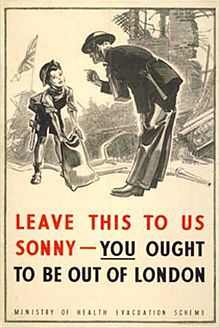
Bit of history: The evacuation of Britain's cities at the start of World War Two was the biggest and most concentrated mass movement of people in Britain's history. In the first four days of September 1939, nearly 3,000,000 people were transported from towns and cities in danger from enemy bombers to places of safety in the countryside.
Most were schoolchildren, who had been labeled like pieces of luggage, separated from their parents and accompanied instead by a small army of guardians - 100,000 teachers. By any measure it was an astonishing event, a logistical nightmare of co-ordination and control beginning with the terse order to 'Evacuate forthwith,' issued at 11:07 am on Thursday, 31 August, 1939. Few realized that within a week, a quarter of the population of Britain would have a new address
"When you watch an old war movie and see the B-17 Flying Fortresses over England, it was just like that. We would stand in Arnold Park and watch them flying over in droves night after night. There was always a fighter planes in front escorting them.
When I was a teen, dances were held on the lawn in the park and as the planes flew over filling the sky, the Army band would play, "Silver Wings in the Moonlight" and "Coming in on a Wing and a Prayer", both popular songs then." --Joan Shelton

"We were encouraged to bring all metal such as old saucepans and other things that we could manage without and turn them in for the war effort. The government even took down all wrought iron gates and fences around buildings, all for the war effort. We learned after the war that it was done to keep up the moral of the people, so they would think they were serving the war effort. Don't know whatever happened to all that scrap metal." --Joan Shelton
Bit of history: "Gas had been used a great deal in the First World War and many soldiers had died or been injured in gas attacks (including Joe Shelton, my grandfather). Mustard gas was the most deadly of all the poisonous chemicals used during World War I. It was almost odorless and took 12 hours to take effect. It was so powerful that only small amounts needed to be added to weapons like high explosive shells to have devastating effects. There was a fear that it would be used against ordinary people at home in Britain."
By September 1939 some 38 million gas masks had been given out, house to house, to families. They were never to be needed. Everyone in Britain was given a gas mask in a cardboard box, to protect them from gas bombs, which could be dropped during air raids.
Children had to take regular gas drills at school. They found these drills hard to take seriously, especially when they discovered blowing out through the rubber made 'rude' noises!
I wanted to include some of Momma's overall impressions of the war. Remember she was 12 when the war started and 18 when it ended. --Mom
"In the midlands, we did not suffer from the bombing like those in the coastal towns and in London. Sometimes a stray bomb would fall in some nearby field, and all us kids would troop out to look at the crater and search for shrapnel. After an air raid, the ground would be peppered with strips of foil, which the Germans would drop to confuse the British radar and protect their aircraft."
--Joan Shelton
Bit of history: Chaff is a radar countermeasure in which aircraft or other targets spread a cloud of small, thin pieces of aluminium, metalized glass fibre or plastic, which either appears as a cluster of secondary targets on radar screens or swamps the screen with multiple returns.
"I think what upset me the most during the war was hearing the radio broadcasts and seeing the newsreels of ships being sunk, the terrible loss of life, and the evacuation of British children to the countryside to avoid the bombing in the cities. It was heart wrenching to see the faces of the parents left behind and to see both parents and children crying. Some of the parents were killed later in the bombings." --Joan Shelton

Bit of history: The evacuation of Britain's cities at the start of World War Two was the biggest and most concentrated mass movement of people in Britain's history. In the first four days of September 1939, nearly 3,000,000 people were transported from towns and cities in danger from enemy bombers to places of safety in the countryside.
Most were schoolchildren, who had been labeled like pieces of luggage, separated from their parents and accompanied instead by a small army of guardians - 100,000 teachers. By any measure it was an astonishing event, a logistical nightmare of co-ordination and control beginning with the terse order to 'Evacuate forthwith,' issued at 11:07 am on Thursday, 31 August, 1939. Few realized that within a week, a quarter of the population of Britain would have a new address
![]() |
| the B17 Flying Fortress |
When I was a teen, dances were held on the lawn in the park and as the planes flew over filling the sky, the Army band would play, "Silver Wings in the Moonlight" and "Coming in on a Wing and a Prayer", both popular songs then." --Joan Shelton

"We were encouraged to bring all metal such as old saucepans and other things that we could manage without and turn them in for the war effort. The government even took down all wrought iron gates and fences around buildings, all for the war effort. We learned after the war that it was done to keep up the moral of the people, so they would think they were serving the war effort. Don't know whatever happened to all that scrap metal." --Joan Shelton
Bit of history: "Gas had been used a great deal in the First World War and many soldiers had died or been injured in gas attacks (including Joe Shelton, my grandfather). Mustard gas was the most deadly of all the poisonous chemicals used during World War I. It was almost odorless and took 12 hours to take effect. It was so powerful that only small amounts needed to be added to weapons like high explosive shells to have devastating effects. There was a fear that it would be used against ordinary people at home in Britain."
By September 1939 some 38 million gas masks had been given out, house to house, to families. They were never to be needed. Everyone in Britain was given a gas mask in a cardboard box, to protect them from gas bombs, which could be dropped during air raids.
Children had to take regular gas drills at school. They found these drills hard to take seriously, especially when they discovered blowing out through the rubber made 'rude' noises!
Sunday, May 13, 2012
“You may say I'm a dreamer, but I'm not the only one. I hope someday you'll join us. And the world will live as one.” ― John Lennon
![]() |
| German prisoners of war bringing in the harvest |
There were hundreds of POW camps spread across the UK and a fair number in Nottinghamshire.
Prisoners would progress through a series of camps, where their political allegiances were determined. Non-Nazis were graded “White”, dubious cases were “Grey”, and hardened Nazis were “Black”. Prisoners wore patches with these colours so that they were known.
As a general rule, the “Blacker” the grading, the further North the camps where prisoners would be housed. Prisoners were also shipped to camps in Canada, and later the US, to safeguard security as much as lack of space.
![]() |
| Wehrmacht (German) soldier |
What follows are my favorite of Momma's war stories. Both involve soldiers. It's amazing to me that at age 85 her memories are still so vivid. --Mom
"I was staying at my sister, Win's, house. It was early, about 7 am, and I was in the back kitchen getting ready for work, when there was a light tap on the back door. Win had a recessed porch at the back, and thinking it was my brother, Jack, I opened the door. There stood a German prisoner of war in a peaked hat and the short jacket of the Wehrmacht, holding out a tin cup.
I was so scared, I screamed and promptly slammed the door and slid the bolt. Win's house backed up onto some fields; I assumed he'd escaped from one of the neighboring POW camps and walked across the fields."-- Joan Shelton
"Did I ever tell you the story about what happened to me just before the invasion of Europe (DDay, June 6, 1944)? I was 17 years old and was pushing Lesley, my niece, in a large pram up Redhill to her home, after visiting Nanna. It was a Sunday afternoon. An army convoy, filled with free French and American soldiers, was driving north to reach the ports on the East coast. The Free French, British, Canadians and Americans would be landing on the beaches of Normandy to invade Europe a few days later.
They were very excited because everyone thought the invasion would be the 'beginning of the end.' When the Americans came level with me, they started tossing out candy bars, chewing gum and other sweets that we had not had much of during the war. What I scrambled to pick up filled the apron cover on the pram. The soldiers were all singing their national anthems trying to out do each other.
When Win saw the candy her first words were, 'Where the bloody hell did you get all those from?' I told her to go down Redhill, hold out her apron and she might get even more."
-- Joan Shelton
Bit of history: "The Free French Forces were partisans in World War II who continued the struggle against the Axis powers after the surrender of France in June 1940. The movement was launched by General Charles de Gaulle, a French government minister who had escaped to Britain, planning to organise continued resistance from there.
By mid-1944, the Free French numbered more than 400,000, and they participated in the Normandy landings and the invasion of Southern France, eventually leading the drive on Paris. Soon they were fighting in Alsace, the Alps and Brittany, and by the end of the war in Europe, they were 1,300,000 strong - the fourth-largest Allied army in Europe."
![]() |
| The liberation of Paris in 1944 |
![]() |
| General DeGaulle entering liberated Paris in August 1944 |
Sunday, May 6, 2012
"If we are to teach real peace in this world, and if we are to carry on a real war against war, we shall have to begin with the children." Mahatma Gandhi
"During the war an English Traitor named William Joyce or Lord Haw-Haw (as he was called by the British public), would broadcast from Germany, taunting his listeners. We kids would purposely tune him in to hear him and to hear Dad curse at him. After nights of bombing in Coventry and surrounding cities, Lord Haw-Haw came on the radio, saying, 'Yes, Nottingham, you think you've escaped it, but it will be your turn tomorrow night!' Sure enough, the next night the Luftwaffe came over to bomb Nottingham."--Joan Shelton
Bit of history: William Joyce, Lord Haw-Haw, was an Irish-American politician and Nazi propaganda broadcaster to the UK during the Second World War. In late August 1939 just before war was declared, Joyce and his wife fled to Germany. At the end of the war, he was hanged by the British as a result of his wartime activities. Since he had possession of a British passport, he owed allegiance to the UK and so was convicted of treason.
Bit of history: On the nights of May 8th and 9th, 1941, the Luftwaffe attacked Sheffield, Hull, Derby, and Nottingham. In all 424 bombs landed on Nottingham, causing numerous fires, killing a few hundred people, and leaving over 1, 286 people homeless. Nottingham may have been bombed because the Raleigh Bike factory produced 20 mm cartridge cases which were the main armament for the Spitfire planes.
"I was sleeping at my sister, Doll's house during the Nottingham blitz, along with my sister, Win. Win and I were in bed because we were too lazy to go downstairs and get under the table with Doll. Under the table was our makeshift air raid shelter. Jack, Doll's husband, who was in the Fire Service, came home next morning and yelled at us for staying in bed. The Germans had leveled the center of Nottingham, trying to bomb the gun factory. Instead they hit a huge bakery, and many were killed. The German pilots would follow the River Trent to find their targets.
![]() |
| Friar's Lane, bombing May 1941 |
After a bit, I went to stay with my sister Win as she was expecting, and her husband, Les, was away in the Navy. When she went into labor, I rode by bike down Redhill to fetch Mam. It was 2 am, and I went to get the midwife and walk back with her to Win's on Henry Street.
Lesley was born that morning. Her dad, Les, did not see her until she was a year old. He was taken off his ship in Halifax, Nova Scotia, with a ruptured appendix. By some fluke, a neighbor across the street from Win's was sent to replace Les on his ship, and he took the wire announcing that Les had a daughter."
--Joan Shelton
Bit of history: "Keep Calm and Carry On" was a propaganda poster produced by the British government in 1939 during the beginning of the Second World War, intended to raise the morale of the British public in the event of invasion. Seeing only limited distribution, it was little known.
The poster was rediscovered in 2000 and has been re-issued by a number of private companies, and used as the decorative theme for a range of other products. There were only two known surviving examples of the poster outside government archives until a collection of about 20 originals was brought in to the Antiques Roadshow in 2012 by the daughter of an ex-Royal Observer Corps member.
Sunday, April 29, 2012
"Until lions have their historians, tales of the hunt shall always glorify the hunter." --African proveb
"The Christmas of 1939, my classmates and I were all dressed and lined up in the school yard ready to go into the classroom for our holiday party. Along game a Gerry plane and 'boom-boom' went Big Bertha. The teachers hustled us into the air raid shelter instead of into the party. After the war we found out that hundreds of civilians died in air raid shelters, often because the walls blew out and the thick concrete roofs caved in on people.
If you had a back garden, the council would come and build an Anderson Shelter. It was made of steel corrugated panels and was covered with soil. People often grew vegetables and flowers on top. There was a bench seat inside which could serve as a bed at night.
The council built a concrete shelter (not an Anderson Shelter) in our back garden but Dad, doubting its safety, would not let us use it. He and Jack dug a huge hole at the top of the garden, lined it with railway sleepers, roofed it, and built a couple of bunks inside. We used this when the sirens went off warning of German planes overhead.
At the beginning of 1940, the government began rationing food. Each week each person got 2 ounces of butter, the same of margarine and lard, 8 ounces of meat (half of which had to be taken in canned corned beef), and 8 ounces each of sugar and flour.
We were more fortunate than most because Dad worked on a farm every Friday repairing machinery and shoeing horses, and he was able to take some of his pay in poultry, rabbit, eggs, and sometimes, bacon.
Dad had four allotments where we grew vegetables, so Mam salted beans and pickled red cabbage and onions. Potatoes, we bought from Mr. Moss by the sackful. Mr. Fish, the baker, would bring us a sack of flour, so we had homemade bread right through the war. Sheep's head soup and beef tongue were plentiful. We were able to get fish until the U-boats started sinking the fishing fleet. I remember seeing canned whale meat at the fish shop; my Aunt Alice would buy it and fry it--ugh! She also bought tripe (the stomach of a cow), cut it into squares and fried it, too.
The war was the start of queuing for which we British became famous. If one heard of a shop that had received something special, word spread like wildfire, and before the shopkeepers could unpack the goods, there would be a queue outside." -- Joan Shelton
3 pints of milk
If you had a back garden, the council would come and build an Anderson Shelter. It was made of steel corrugated panels and was covered with soil. People often grew vegetables and flowers on top. There was a bench seat inside which could serve as a bed at night.
The council built a concrete shelter (not an Anderson Shelter) in our back garden but Dad, doubting its safety, would not let us use it. He and Jack dug a huge hole at the top of the garden, lined it with railway sleepers, roofed it, and built a couple of bunks inside. We used this when the sirens went off warning of German planes overhead.
At the beginning of 1940, the government began rationing food. Each week each person got 2 ounces of butter, the same of margarine and lard, 8 ounces of meat (half of which had to be taken in canned corned beef), and 8 ounces each of sugar and flour.
We were more fortunate than most because Dad worked on a farm every Friday repairing machinery and shoeing horses, and he was able to take some of his pay in poultry, rabbit, eggs, and sometimes, bacon.
![]() |
| Anderson Air Raid Shelters in a backyard, unfinished on the left finished on the right. |
![]() |
| The interior of a type of communal air raid shelter. The boxes the girls are carrying hold their gas masks. |
Dad had four allotments where we grew vegetables, so Mam salted beans and pickled red cabbage and onions. Potatoes, we bought from Mr. Moss by the sackful. Mr. Fish, the baker, would bring us a sack of flour, so we had homemade bread right through the war. Sheep's head soup and beef tongue were plentiful. We were able to get fish until the U-boats started sinking the fishing fleet. I remember seeing canned whale meat at the fish shop; my Aunt Alice would buy it and fry it--ugh! She also bought tripe (the stomach of a cow), cut it into squares and fried it, too.
The war was the start of queuing for which we British became famous. If one heard of a shop that had received something special, word spread like wildfire, and before the shopkeepers could unpack the goods, there would be a queue outside." -- Joan Shelton
![]() |
| an adult's rationed food for a week |
3 pints of milk
3 /4 lb - 1 lb meat
1 egg or 1 packet of dried eggs every 2 months
3-4 oz cheese
4 oz bacon and ham
2 oz tea
8 oz sugar
2 oz butter
2 oz cooking fat
Bit of history: Every member of the public was issued a ration book which contained coupons that shopkeepers cut out or signed when people bought food and other items. The color of your ration book was very important as it made sure you go the right amount and types of food needed for your health.
Most adults had buff colored ration books. Pregnant women, nursing mothers and children under 5 had green ration books. They had first choice of fruit, a daily pint of milk and a double supply of eggs. Children between 5 and 16 years of age had blue ration books. It was felt important that children had fruit, the full meat ration and half a pint of milk a day.
Fourteen years of food rationing ended at midnight on July 4, 1954, when restrictions on the sale and purchase of meat and bacon were lifted. The war ended 9 years earlier in 1945
"Sometime they'll give a war and nobody will come." Carl Sandburg
Bit of history: For Great Britain, World War Two began in September 1939. Following Germany's invasion of Poland, Britain and France declared war on Germany. Nottingham was bombed on May 8th. and 9th., 1941, by the Nazi German Luftwaffe. On May 8, 1945, Winston Churchill announced VE (Victory in Europe) Day, and for Britain the war was finally over.
Erik,
Momma was 12 when the war started in 1939 and turned 18, fourteen days before the war ended. Through the years she has shared many "home front" memories. Enjoy!
--Mom
"I remember the Sunday morning that war broke out. It was 11 am., September 3, 1939, and we were all gathered around listening to the radio. I was scared because we had seen pictures of the bombing of Poland (Germany invaded Poland in 1939), and we knew we were in for some of the same once the war got going.
Bit of history: "During the Second World War besides their normal duties such as subduing drunken brawls and arresting boys who stole apples, they (the Special Constabulary) were trained to deal with a wide range of eventualities such as first aid in case of injury, initial coordination of the security of aircraft crash sites, clearing people from the vicinity of unexploded bombs, handling of unignited incendiary bombs and checking compliance with lighting regulations."
Erik,
Momma was 12 when the war started in 1939 and turned 18, fourteen days before the war ended. Through the years she has shared many "home front" memories. Enjoy!
--Mom
"I remember the Sunday morning that war broke out. It was 11 am., September 3, 1939, and we were all gathered around listening to the radio. I was scared because we had seen pictures of the bombing of Poland (Germany invaded Poland in 1939), and we knew we were in for some of the same once the war got going.
Dad was already in the Special Constabulary, an unarmed volunteer organization. He was given a blue tin hat with Police stenciled on it, a night stick, a band to wear around his upper arm with "Special Constabulary" printed on it, and a military style gas mask. That first night the sirens started wailing. Oh, it was the most awful sound to my young ears. Dad took off to patrol the streets with his partner. I was sleeping in Mam and Dad's bedroom on a single bed pushed up against the outside wall of the room. Shaking with fear, I jumped over into their bed and snuggled up to Mam.
After that I would not sleep in my own bed because I had visions of being blown into the street if a bomb dropped. Mam and Dad moved the furniture around and placed my bed as far away from the window as possible. Things were pretty quite for a few months, and then, a huge gun was placed on a nearby hill in a wooded copse (a small group of trees). We called it Big Bertha; when it fired the doors and windows rattled. Those living nearest to it even had windows broken! The authorities came out with a lace covering with glue size on it. We cut it to size and pasted it to the inside of the windows. It stayed there until the war was almost over. "
--Joan Shelton
![]() |
| Special Constabulary tin whistle |
![]() |
| World War II tin armband |
![]() |
| Special Constabulary tin hat |
| military-style, World War II gas mask and carry bag |
Bit of history: "During the Second World War besides their normal duties such as subduing drunken brawls and arresting boys who stole apples, they (the Special Constabulary) were trained to deal with a wide range of eventualities such as first aid in case of injury, initial coordination of the security of aircraft crash sites, clearing people from the vicinity of unexploded bombs, handling of unignited incendiary bombs and checking compliance with lighting regulations."
Wednesday, March 14, 2012
"We all grow up with the weight of history on us."
"We all grow up with the weight of history on us. Our ancestors dwell in the attics of our brains as they do in the spiraling chains of knowledge hidden in every cell of our bodies." ~Shirley Abbott
Joseph Shelton was born November 13, 1897, in Arnold, Nottingham, England. The second eldest of six boys, he left school at age 12 with rheumatic fever and consequently, wasn't able to read and write until he was in his 20's.
His father, John Thomas Shelton, had a little hardware shop at the bottom of Atherley's yard on Front Street in Arnold. He also had a horse and dray (cart) and peddled household wares such as kerosene, gas mantles, clothes pegs, and other necessities to the villages around Arnold--Lambley, Lowdham, Oxton, and Calverton. When Joe left school at 12, he helped his dad and eventually took over the business when his dad died at age 42. In 1914 at age 17, lying about his age, he went into the army with the Sherwood Foresters. He was in Dublin, Ireland in 1916 in the Irish Rebellion and fought in WWI in 1917. He was mustard gassed at Ypres, Belgium, and did not regain consciousness until he was back in England. He told Dad that he bayoneted and killed a German soldier; after rifling through his pockets, he found a photo of a wife and children. He had nightmares about that until he was 30.
After recovering from his war injuries, he worked as a coal miner. After a nationwide strike in 1926, miners wages were cut by 50%. By 1935, no longer able to make a decent living as a miner, he went to work in a factory, Erikson's Telephone.
Bit of history: The Irish Rebellion was a revolt in Ireland during Easter Week, 1916. It was mounted by Irish Republicans who wanted to end British rule in Ireland and establish the Irish Republic. At the time the British Empire was heavily engaged in the First World War.
During World War I intense and sustained battles between the Germans and Allied Forces, occurred at Ypres, Belgium. British soldiers nicknamed the small city "Wipers" because of the difficulty of pronouncing Ypres in English. Mustard gas was used for the first time ever near Ypres in the autumn of 1917. The symptoms of mustard gas (Yiperite) are the formation of large blisters filled with yellow fluid on exposed skin and in the lungs, intense itching and skin irritation, and an increased risk of developing cancer later in life.
![]() |
| Joseph Shelton, age 17, in uniform |

![]() |
| Left to right, Albert Strutt, Hannah Strutt, Emily Shelton, and Joseph Shelton--my grandparents. |
Maureen remembers Pop giving her a drink of Advacar (an egg based liqueur that tastes like egg custard) at Christmas and having "crackers" to pull. A cracker is a decorated paper tube, twisted at both ends. A person pulls on each end and the cracker breaks, a small chemical strip goes "pop" and the contents, a small gift, a joke, and a paper crown fall out.
Pop had a lovely garden on the side of the house; he grew many things, but I loved watching him take a fork and turn over the "new" potatoes (immature potatoes harvested during the spring). They were so good boiled and served with mint. He also carved the loveliest miniature chairs. I adored him.
![]() |
| Joseph Shelton, Barbara, age 18-19, and Emily Shelton |
Subscribe to:
Posts (Atom)
_strutt.jpg)