Tuesday, April 5, 2016

"Comparison is the thief of joy." --Theodore Roosevelt

Momma remembers,

     "In 1965 IBM built a new plant in the Research Triangle Park near Raleigh, North Carolina.  Frank requested a transfer to move back to the South; we did not like the excessive snow in Poughkeepsie, New York.  He was hired, and we bought a brand new house, our first new home, in Cary, North Carolina, outside of Raleigh.  We had to stay in a motel until the house on Meadow Drive, a split-level, was ready.  It was beautiful, my favorite house.


     Cary was a great place for Darryl.  He and his three friends spent summer days at the creek across the road catching crayfish, wading, and exploring.  Immediately after breakfast, Darryl would go out to play and come home only when he was hungry.  It was an idyllic place to grow up.


Darryl, age 5


     He went to kindergarten at the local Lutheran church; there his artistic talent was first noticed.  The teacher called me in to show me his painting of a daffodil in blue water, painted from a still life.  She raved about it because the daffodil had drawn up the blue water, the edges of its petals tinged with blue-green, and Darryl had captured that so well in his painting.           
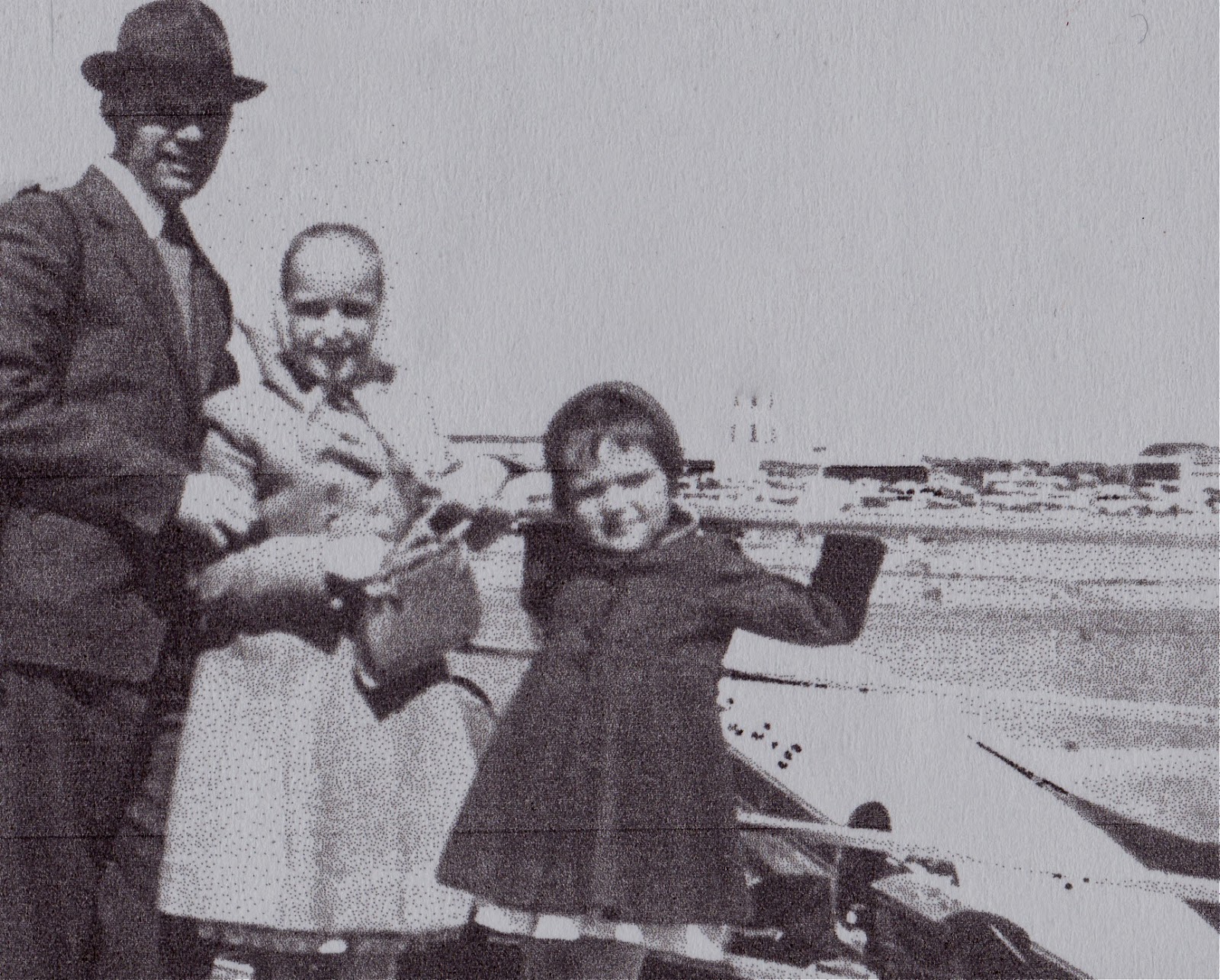
Darryl and Dad
     Barbara started at Cary Elementary School on South Academy Street, and then attended junior high at West Cary Middle School.
     Unlike Poughkeepsie, we settled easily into life in Cary.  It was a happy time."


Cary  Elementary School on South Academy Street, Cary, NC
There has  been a school at this site since 1879.


Maureen remembers,

     "In 1967 we moved to Cary, NC, just as I was going into 10th grade; I graduated from Cary High School and then went to college in the Fall at the University of Virginia, Richmond.  When we first arrived in Cary, we stayed in a motel on Main Street and ate in a little restaurant near the motel.  That was probably where and when I developed my love of chef salad.  I had one often, minus the hard
boiled egg.

Maureen, age 16
     From Meadow Drive where we lived, I walked to the elementary school and caught a school bus out to Cary High School.  My favorite class was art;  I remember doing a tissue paper collage which was put in a glass cabinet near the school office.  A community member came through one day,  liked it, and bought it for $10.  One Christmas, two classmates and I were invited to paint store windows in Raleigh.


     I learned to drive in Cary; I took Driver's Education at high school, but I really learned to drive at Frank Shelton's School of Driving where Dad fine tuned my driving--I recall coming down a hill in Cary and having him suddenly scream, 'STOP!'  I, of course, slammed on the brakes.  He said he yelled 'stop' in case a child had been running out of the driveway into the road.  I went with him to Raleigh to get my license; his office at IBM was near the DMV, so after getting my license, my first test was to drop him off at work and drive myself home.  It was a 10-15 mile trip, and I did it!

 
     During my senior year of high school, I got a job in nearby Raleigh at a bakery at Cameron Village, the first outdoor shopping center between Washington, D.C., and Atlanta.  I made (wait for it) $1. an hour!  Talk about a minimum wage!  I wore a white uniform, and part of my job was scooping frosting out of a big plastic bucket, slathering it onto big metal trays of brownies and cutting them into rectangles before sliding the trays into a glass cabinet."

Cameron Village, opened in 1949


 FYI:  Not sure Maureen knows this but Cameron Village, where she got her first job, is famous but not only as the first shopping center between Washington, D.C. and Atlanta.  During the 60's, when Maureen worked at a bakery there, it was part of the Civil Rights Movement (1954-1968)--


February 10, 1960. "Inspired by the Greensboro sit-in earlier that month, students from Shaw University and St. Augustine’s College in Raleigh planned a sit-in at Woolworth’s in Cameron Village to protest segregation at lunch counters.  With protests arising throughout the state, Woolworth’s had closed before they arrived.  Students began picketing outside the restaurant’s doors,  and after repeated warnings from the manager, 41 students were arrested for trespassing.  Despite these arrests, these and other local activists helped push civil rights forward.  By 1964 most businesses in Raleigh had desegregated."


     "Cary was idyllic in many ways.  In the 60's it was a small Southern town, with a population of about 3,500.  The library was in a tiny, white frame house on South Academy Street.  On the corner of South Academy and Main Street was Ashworth Drugs, where Barbara and I enjoyed the hamburgers, hot dogs and Cherry Crush at a soda fountain counter. They had a special way of making the burgers and dogs, piling slaw & chili on top.  I can still smell them today.
     Our split level home had a downstairs den; I remember sitting there in front of the tv watching Neil Armstrong walk on the moon.  'Peyton Place,' a weekly serial show with Mia Farrow, was running while I was in high school, so that was a weekly watch, as well as some of the music-performance shows like American Bandstand.
     We used to visit Aunty Gladys (Dad's sister) in Lenoir, NC, now and again, and her girls, Susan & Karen, spent time with us in the summer.  Mam taught them how to sew.  We had a little trailer that we would take up towards the mountains near Blowing Rock on a Friday after Dad got home from work.  Sometimes we'd take it down to the beach, too."


Ashworth Drugs, on the corner of South Academy and Main


Our little trailer, Dad, and Mitzi

Saturday, July 5, 2014

“All my life I have lived and behaved very much like the sandpiper . . .

 just running down the edges of different countries and continents, looking for something.” 
                                                                                                                                         ― Elizabeth Bishop
                    “There's a race of men that don't fit in, 
                             A race that can't sit still;
                             So they break the hearts of kith and kin, 
                             And they roam the world at will.
                             They range the field and rove the flood, 
                             And they climb the mountain's crest; 
                             Their's is the curse of the gypsy blood, 
                             And they don't know how to rest.” 
                                                                                                  ― Robert W. Service

Erik,

     As you may remember, Poppa was consumed by wanderlust.  When he was in the US he couldn't get England out of his system, and when in England, he pined for America.  While in the States he was always wanting to move somewhere new, never happy where he was.  We moved quite a bit--Hickory, Statesville, Poughkeepsie, Cary, Huntsville, San Jose, and Hollister. 

     I don't think it was about a love of travel or even seeing and doing spectacular things; I think it was more a restlessness in him, his wanting to 'get on' and be successful.  That probably had a lot to do with having had a difficult childhood.  He always seemed to be running away from something, but I never knew what.
                                                                                                          Mom


Momma remembers:

     "Frank was always going to the local library looking in out-of-state newspapers at the 'help wanted' sections.  He found an ad for a company in New York looking for an engineer.  He sent his resume, and the company, which turned out to be IBM, hired him, and that is how we moved to Poughkeepsie.

     We left Statesvile in March 1964.  In Poughkeepsie, we stayed in a motor motel (a hotel designed for motorists) with cottages clustered around a pond.  The temperatures went way down below zero, so Barbara, Maureen, and Frank were able to ice skate, a novelty coming from the South.
     We arrived in a blizzard.  When Frank awoke the first morning of his new job, the temperature had dropped to 28 below zero, and our car, an older Oldsmobile, wouldn't start.  He was so scared he'd lose his job if he didn't show up for work, so he walked!  The plant was only about two miles away, but it was 28 below zero!  When he finally got there, and his coworkers heard that he'd walked, they told him he could've died.  Someone from work gave him a ride back to the motel, and the motel owner ran him to work whenever the car wouldn't start.  We stayed at the motel about 3-4 weeks.
     We had a bit of a rough start.  Maureen and Barbara were entertaining Darryl, swinging him about in the motel room, and he hit his head on the sharp corner of a coffee table.  We had to rush to the emergency room to get him stitched up.
     Eventually we bought and moved into a split level house at 46 Nassau Road in a planned development called Crown Heights.  Since we had no family and no friends in New York, we would go sightseeing at every opportunity.  We loved the countryside in New York. It reminded us so much of Derbyshire in England with dry stacked stone walls dividing the properties.
     Once we took a week long car trip to Niagara Falls and the Finger Lakes and enjoyed a boat ride on one of the lakes.  Upstate New York was beautiful, so we took advantage of all there was to see. I also enjoyed the food there, so different from the South. At the local market I would chat with the butcher and the fishmonger; he was amazed that I could name all the fish."


     The Finger Lakes are a pattern of lakes in the west-central section of Upstate New York.  They are a popular tourist destination. The lakes are long and narrow (resembling fingers), and are oriented roughly on a north-south axis.


     "I think moving to Poughkeepsie put us on our feet financially.  It was a good move."

                                                                                                            --Joan Shelton


Maureen's memories of Poughkeepsie--


     "I enjoyed living in Poughkeepsie and made good friends at Spackenkill Junior HIgh School--Debbie Purdy, Eileen Tritschler, Ann Smythe, and Martha Van Buren.  Debbie and I lived the closest to each other and would bike to each other's homes, or ask a parent to drive us to the local mall to shop or go to a movie.

     IBM had a country club for their employees with a club house, golf course, and, in the Winter, an outdoor ice skating rink.  Barbara and I would walk up there and sled down the golf course hills when we got a good snowfall, and I would go there to ice skate.  They would also host musical groups for entertainment, and it was there, when I was 15, that I saw Diana Ross and the Supremes and The Dixie Cups.
The Dixie Cups are an American pop music girl
group of the 1960s.  They are best known for
their 1964 million-selling record
"Chapel of Love."
    
     We went to Zion Episcopal Church in Wappinger Falls, a nearby town.  One Sunday morning, Mam, Barbara, Darryl and I came home from church, and Dad, who wasn't much of a church goer, had for some reason decided to give Mitzi, our standard poodle a haircut.  He had sheared the poor dog to the skin, and we were all mad at him for a week.
     We did sightsee a lot while living in New York.  We went to West Point Military Academy, drove along the Hudson River, to Hyde Park, Franklin Delano Roosevelt's house, toured the Catskill Mountains, the Fingerlakes, and visited a Santa's village in upstate New York.


Santa's Village, North Pole, N.Y.

     We had nice neighbors across the street,  Tony and Maurice.  Her father owned a bakery, and she brought us the best brownies, thick with chocolate frosting, and from time to time, a deep dish style pizza.  It was more of a focaccia style bread with tomato sauce and cheese on it, but no other toppings.

   They had no children, so perhaps doted on the three of us.  I remember when President Kennedy was assassinated, Tony, who worked in a book publishers, bought us each a commemorative book, The Torch is Passed.


     In 1965 Mom went back to England on an IBM charter flight, taking Darryl with her.  Her flight left from Dulles in Washington, D.C., so we drove down there from New York, and after seeing her off, Dad took Barbara and me to see the sights around and including the Lincoln Memorial.   We also stopped in New York City on the way back home, and he took us up the Empire State Building and on a boat ride around Manhattan.


     Mam especially enjoyed New York; she found the people and culture there more like England than in the South. "

Monday, February 17, 2014

"Never underestimate the power of a woman . . .

                                                                                                  with a sewing machine."

Erik,

     This page is really an excuse to include photos that didn't fit anywhere else.  As I was looking through old photos I noticed that there were a lot of me and Maureen in outfits that Momma had made for us.  If you remember she left school at 14 and started working as a seamstress at Clark's Factory in Nottingham. 
     When we came to the States, Mam continued making nearly all our clothes.  I remember begging for a store bought dress.  I've included a picture of that dress below.  Maureen says Mam never used a pattern when she made outfits for us!
                                                                                                                    Mom
1959, Easter outfits with mataching hats and, in my
case, a matching purse
For Easter 1961, Momma made these suits.
Maureen's was lavender and white, mine
was green and white.


On the back, Dad had written,"This is up at
Blowing Rock Park, taken on the look-out
tower.  Don't they look nice?"
July 1959 at Viewmont Apartments,
Hickory, N.C.


Taken in Hickory, N.C. at the Viewmont
Apartments.  Maureen's dress was bought
at  Sears in Hickory.  Mam made Barbara's
dress and knitted her sweater.


I begged for this store bought dress.  It was mint
green with rose colored flowers embroidered on
the bodice and sleeves.


Monday, January 20, 2014

Our hearts grow tender with childhood memories and love of kindred . . .

and we are better throughout the year for having, in spirit, become a child again at Christmas-time.
                                                                              --Laura Ingalls Wilder


Momma's memories of Christmas as a child--

     "Christmas, when I was a child, was family time.  I remember my Mam did a lot of cooking but still managed to make knitted outfits for Christmas dolls and clothes for me and, later, for Molly.  One Christmas I got a doll with beautiful hand knit outfits; another year I received a black doll dressed in a red knitted outfit--I thought she was so beautiful.  Molly was born at home Christmas morning, 1932, and because I was only 5 years old, I was taken to Aunty Ginny's (Nanna's sister) until one of my older sisters came to fetch me back home.
     We had a very small tree; Mam would put it on top of a high bookcase so the cat could not pull it over.  We would string intricate, gaily colored garlands from each corner of the room to the light fixture in the middle, like spokes on a wheel.  I don't think Mam appreciated them much. We had no clothes dryer in those days, and since it was impossible to dry things outside in England in the Winter, a clothes line was strung across the main room when we went to bed at night, and the sheets and towels were hung up to dry overnight.  It was a jumble to have all those holiday garlands and washing hanging about, especially because the custom in England was to leave decorations up until the evening of January 5, the eve of the Epiphany (when the three wise men visited the baby Jesus) and formerly the twelfth and last day of Christmas festivities.  I know Mam could hardly wait to get those garlands down.
In the 1930's the chocolate makers added novelty
items to the holiday selection packs,
such as this clock (center)

     Molly and I, the two youngest, always received the same gifts in a white pillow slip tied with a big red bow and placed on the bottom of our bed.  We were awake by 5 a.m., eagerly going through those pillow slips.  We always received a huge Selection box of Cadbury's or Rowntree's chocolates, games, books and clothes.
     Before the war food was abundant at the holidays and included mince pies, fruit cake with marzipan and royal icing, a Christmas plum pudding with custard on top, and a large pork pie for Christmas breakfast.

British Christmas cake--fruit
cake with marzipan and Royal
icing


     Usually Christmas dinner was eaten midday and was a goose or a pork roast.  A light 'tea' would be served around 5 p.m.  Auntie Ginny, Mary, and Uncle Tom always came for tea and afterwards the grown-ups would play cards. Molly and I didn't care much for Uncle Tom because he was such a grouch, so we would look at his cards and then signal with our eyes to the other players. Eventually he caught on, threw his cards down, and stormed off.  We all felt so sorry for Auntie Ginny, and I think Mam and Dad only tolerated Uncle Tom for Ginny and Mary's sake.

     The stores in Nottingham had wonderful Christmas displays; Molly and I would go in, sit down, and go on a 'journey' to the North Pole; one Christmas the ride was a 'submarine.'  It was magical, and as we exited the ride, we'd always receive a gift from Santa.


a modern day indoor Christmas market in Nottingham
     On Christmas Eve, Mam and Dad would take us to Nottingham's indoor Christmas market to buy a Christmas goose.  Mam was a savvy shopper, always looking for a bargain.
She'd hang around around until nearly closing time, then zero in on the goose she wanted.  While we waited, we'd stuff ourselves with mushy peas.  The shop owner would put the goose in a large straw bag with its head hanging over the side; we'd ride the tram from the city center back to Arnold, walk home, and then Mam would go to work cleaning that bird and getting it ready for the oven next morning.


     When the war started everything changed--no more glittering shop displays because everything was blacked out to prevent lights being seen by the enemy during an air raid.  As the war progressed we were also under more and more severe rationing, so it paid to stay in touch with the butcher and anyone local who raised poultry.  We were more fortunate than others.  Since Dad was a blacksmith, he kept in contact with two or three farmers for whom he did work and was able to barter his work for meat, vegetables, eggs and other things not available with ration cards.

A child sleeps in an air raid shelter festooned with Christmas
decorations--a not uncommon sight during the war
     I was 12 when the war started and 18 when it ended.  At 14 I left school and started working as a seamstress at Clark's Factory.
They made undergarments; I ran an embroidery machine.
     From ages 14-17 I lived with my older sister, Win; her husband Les was away with the Navy.  She was fearful and wanted someone with her.  I did not enjoy it, but did it to spare Mam from having to go and stay with her.


During WWII Westminster Council, London, offered
a prize for the best dressed shelter.  These occupants
have used Christmas decorations and flags, as well as
portraits of the King and Queen and Winston
Churchill--20th. December 1940
     I mentioned above that I had a cat that would try to pull over the Christmas tree.  The cat's name was Lucky and she was one of 3-4 black cats that I had, each named Lucky.
     Uncle Les worked at a Co-op grocery store early in the war years.  The Co-op had cats to keep the mice population down in their food storage areas.  There were always kittens available.  He brought me the first Lucky, and when she got hit by a car on Front Street, he came the next day with Lucky 2 in a paper sack. They would run away or get killed and he'd show up with another--always named Lucky and always black!

     On Boxing Day, usually the day after Christmas, Mam would buy two rabbits from the butcher, hang them up on a big hook in the kitchen, skin then, chop off their heads, clean out the insides, stuff them, and bake them for our dinner.  Dadda would have rabbit brains on toast for breakfast.
                       --Joan Shelton
(Wow, that is one family tradition I'm thankful we no longer observe!)


Bit of history:  

Boxing Day--"In Britain, it was a custom for tradesmen to collect 'Christmas boxes' of money or presents on the first weekday after Christmas as thanks for good service throughout the year.  This custom is linked to an older English tradition: since they would have to wait on their masters on Christmas Day, the servants of the wealthy were allowed the next day to visit their families. The employers would give each servant a box to take home containing gifts and bonuses, and maybe sometimes leftover food.

Saturday, December 28, 2013

“I heard the bells on Christmas Day. . .

Their old, familiar carols play,
And wild and sweet
The words repeat
Of peace on earth, good-will to men!”  ― Henry Wadsworth Longfellow


Although missing the nursery rhyme light shades, I think
this is the tree Mam brought from England


     "In 1959, I came to America with my family aboard the Queen Elizabeth.  Mam packed a small, artificial Christmas tree.  A central wooden dowel sat in a hole in a square base.  It was 3 feet tall with branches that pulled out and down to form the shape of a tree.  It came with light bulbs, each with a shade like an inverted Dixie cup.  A nursery rhyme and character were painted on each shade."


   "In the early 60's, we bought a 5 ft. silvery tinsel tree.  It had a silver painted 'trunk' with holes drilled in it at increasing angles, so that when each of the branches of the same size was inserted into the holes, they would perch upwards forming a tree shape.  My brother Darryl was born during the era of the silvery tinsel tree.  Maybe that's why he loves tinsel so much."


     "In the 70's we had a 6-foot artificial evergreen tree.  It looked real, but didn't smell real.  We three kids could assemble it, no parent help needed.  Dad always put those big, cone shaped, multi-colored lights bubs all over the tree.  Maureen and I begged for fairy lights.  Darryl just wanted to lob tinsel at the tree, big clumps that would drip from random branches."
                                                                                                                 --Barbara

Maureen remembers:

     "I can't say that I remember any Christmases in England.  I would've been 6 years old on my last Christmas there.  I remember Dad taking me down to Nanna's house to receive a gift.  Pop would always give me a small glass of Advocaat at Christmas, a yellow drink that tasted a bit like eggnog.

'Advocaat or Advocaatenborrel is a traditional Dutch alcoholic beverage made from eggs, sugar and brandy. The rich and creamy drink has a smooth, custard-like flavor and is similar to eggnog.'

     I remember more of our first Christmas in Hickory, N. C.  I got a bridal doll that came in a hinged case with a few clothes.  We lived upstairs in a small attic bedroom, but Mam has since said we didn't stay there long after finding rat droppings.
     Mam and Dad would hang a pillow case on our bedposts, and in it would be nuts, fruit and a few gifts.  I believe it might have been the Christmas after we came back from  England, that you and I each received a bridal doll that was about 3 feet tall.

Opening a package from England
We're very dressed up for opening gifts--must have been for
the photos


     I remember a Christmas in the duplex on
Oakland Avenue in Statesville when I received
a Brownie Bull's Eye camera.  First I opened a
package with film, then one with a camera bag,
and finally the one with the camera.  I still have it!
     Every year we went to a Christmas party at Dad's workplace, Hunt Penn.  Mr. Waring, the owner, led the singing.  Each child of an employee received an age appropriate substantial wrapped gift.  They served cupcakes covered in red and green icing.  What a treat!"


FYI:  Below are some British Christmas traditions, some of which we celebrated.

1. Letters
It is very common for school age children to write letters to Santa Claus.  But, the Brits take it a step further and burn the letters in the fireplace so the ashes fly up the chimney and Father Christmas can read the smoke.

2. Stockings
Rather than hanging stockings above the fireplace, British children hang them at the end of their bed hoping they will be filled by Christmas morning.

3. Crackers
The cracker is a paper tube, covered in foil, twisted at both ends. It’s shaped like a large sweet with hidden treasures inside. Each person crosses their arms, using their right hand to hold their cracker, and pulling their neighbor’s cracker with their left. POP! The cracker will make a bit of a bang with the contents spilling out which usually is a joke to be read at the dinner table, a small trinket and a paper crown.

4. Next Year
Brits say you need to take your tree and decorations down within 12 days of Christmas or you’ll have bad luck for the next year.

5: Crown
Everyone is a king on Christmas! The paper crowns are made of tissue paper and unfold into an actual crown. Adults and children alike don the crown making it a colorful sight. The paper hat was added to the crackers in the early 1900s and the tradition has carried on.
                                                                                               --from BBCAmerica


Bit of history:  

     "The most famous Christmas tree in the UK is the giant tree in Trafalgar Square. The tree is a gift from Norway to the people of the UK as a token of gratitude for British support of Norway during the Second World War. Every year since 1947, Norway ships over a spruce tree that the British ceremoniously decorate with white lights.
 
     Crazy costumes, audience participation and cross-dressing all in one performance! What more can you ask for? Pantomime season in the UK begins around Christmastime. The audience always gets excited at pantomime performances, cheering for the heroes and yelling angrily at the villains. The tradition of pantomimes comes from medieval mummers plays, in which men acted all the parts in a silent play with a moral theme for noble households. Today, pantomimes sometimes even feature famous pop stars or TV personalities.

     While some children leave cookies and milk for Santa Claus like in the US, it is quite common in the UK to leave something a little stronger for good old St. Nick. Many families leave a glass of whiskey, sherry or brandy, along with a heartier snack, like a mince pie, made of fruit and spices. It’s a long, cold night for Santa, so they like to give him something to keep him warm.

     Brits used to stay warm by the Yule log during the cold Christmas season. The Yule log was a large piece of wood that was burned in the fireplace as part of the holiday celebrations. Traditionally, it would be decorated with ribbons and dragged into the house ceremoniously. Once it was lit, it would be kept lit throughout all 12 days of Christmas. If you could keep the log burning, it would bring warmth, prosperity, blessings and good luck all year long"
                                                 --from http://usa.britishcouncil.org/british-christmas-traditions

Thursday, December 26, 2013

"The American Dream is all about social mobility in a sense--

                                                            the idea that anyone can make it.     --Fareed Zakaria

Erik,
     "When Mam and Dad were able to purchase their first home in Statesville, NC, they had accomplished something that wouldn't have happened in England at that time.  It was a huge moment, I think.  They were well on their way to 'making it.'"                   --Mom


Maureen remembers:

     "It was in Statesville that Mam and Dad bought us each a bedroom suite (bed, dresser, and desk) from Gordon's Furniture Store.  I still have mine, as does Barbara.


     I was allowed to ride my bike to the library.  I would cut through the back of the high school, cross North Center Street, and ride through a residential area to the front of the library.  I had a basket on my bike; in the summers I went through a lot of Nancy Drew books.
        A few years ago when I visited Statesville, I noticed how small the library (now a Head Start center) actually is; it still looked the same, with curved wrought iron steps on both sides of the front door.


Statesville Drug  Store/Holmes Drug Store
     I would also ride into downtown Statesville and go to the movies.  I remember Cherry Cokes at the corner drug store, Statesville Drug Store or Holmes Drug Store.  On one of my many trips into town, I bought Barbara a tiny china tea set for Christmas.


     I joined a Brownie troop; Mam would help at the meetings.  I remember making a small ceramic fawn and shoe, both of which I still have.  Mam painted the eyes on the fawn.  Barbara and I also made egg cups, her's was a rooster (she still has it) and mine was a duck.


     I was playing over at a Brownie friend's house one day, in the backyard, when her dog jumped up and bit me in the behind.  I had to be taken to the doctors to get a Tetnus shot.  I think that is the reason I've had a fear of large dogs every since.  I stayed in Girl Scouts through high school.
     Our next door neighbors, the Lipshitz family, had a daughter,  Donna, who I often played with.  I needed a dress for a school dance, and Mam had just had Darryl and couldn't get out to the shops, so Mrs. Lipshitz went to a local department store,  Spainhours, and brought home several dressed for me to choose from; I chose a lovely white dress with big green flowers on it.


Maureen holding Patches; Barbara on the far right


     "We had our first dog while living in Statesville, a beagle named Patches.  We were out driving up in the mountains and saw some kids playing with some puppies, stopped, went to the door and asked if we could buy one.   The woman who answered looked so down trodden; the house had a dirt floor.  It made us count our blessings.
     Patches became a memeber of the Shelton household, but he kept running away.  We had just about given up on him, when one day he came home with a piece of rope tied to his collar.  We found out later that he would go and visit at some nearby shacks, and the people who lived there were feeding him, obviously something he liked because he would keep disappearing.  We left Patches home alone one time; when we returned there was toilet paper strewn all over the house."
                                                                                            --Joan Shelton